Aug 19, 2026
 9 min read
Choosing between fleet management solutions can feel straightforward until the shortlists start to look the same. Most platforms promise tracking, reports, alerts, maintenance, and integrations. The real differences show up later: in the hardware you can use, the way the system is deployed, how far it can be adapted, and who supports the project after launch.
A delivery company moving away from spreadsheets, a multinational operator managing a mixed fleet, and a telematics service provider building solutions for multiple customers will not judge the same software in the same way. Their priorities, technical environments, and plans for growth are simply too different.
This guide looks beyond feature lists. It explains how to evaluate a fleet management program around real operating needs and looks at Wialon alongside Geotab, Navixy, Samsara, and Verizon Connect.
The goal is not to crown a universal winner, but to help fleets and service providers understand which trade-offs matter for their business.
How to choose fleet management software
Before jumping into the comparison, let’s define how we’re going to look at the current market offerings. An obvious step when choosing any piece of software is to inspect the feature list. But here, we suggest starting with operational use cases.
-
Define the tasks and decisions the system needs to support: locating vehicles, reducing idling, controlling fuel, scheduling maintenance, coaching drivers, planning routes, or coordinating deliveries.
-
Then identify who will use the system and what information each role needs. A fleet owner may prioritize rapid visibility and simple reporting, while a telematics service provider may need account hierarchies, branding, configurable workflows, a fleet management app, and tools for supporting multiple customers.
-
Next, assess the technical environment. Confirm that the fleet tracking software can work with devices already installed in the fleet’s vehicles or assets, or estimate the cost and disruption involved in replacing them. Review APIs, data exports, ready-made integrations, security, hosting, and scalability. Check how well each platform integrates telematics data with ERP, TMS, BI, payroll, fuel card, maintenance, and compliance systems. We also recommend examining the platform’s stability, update process, and quality of support.
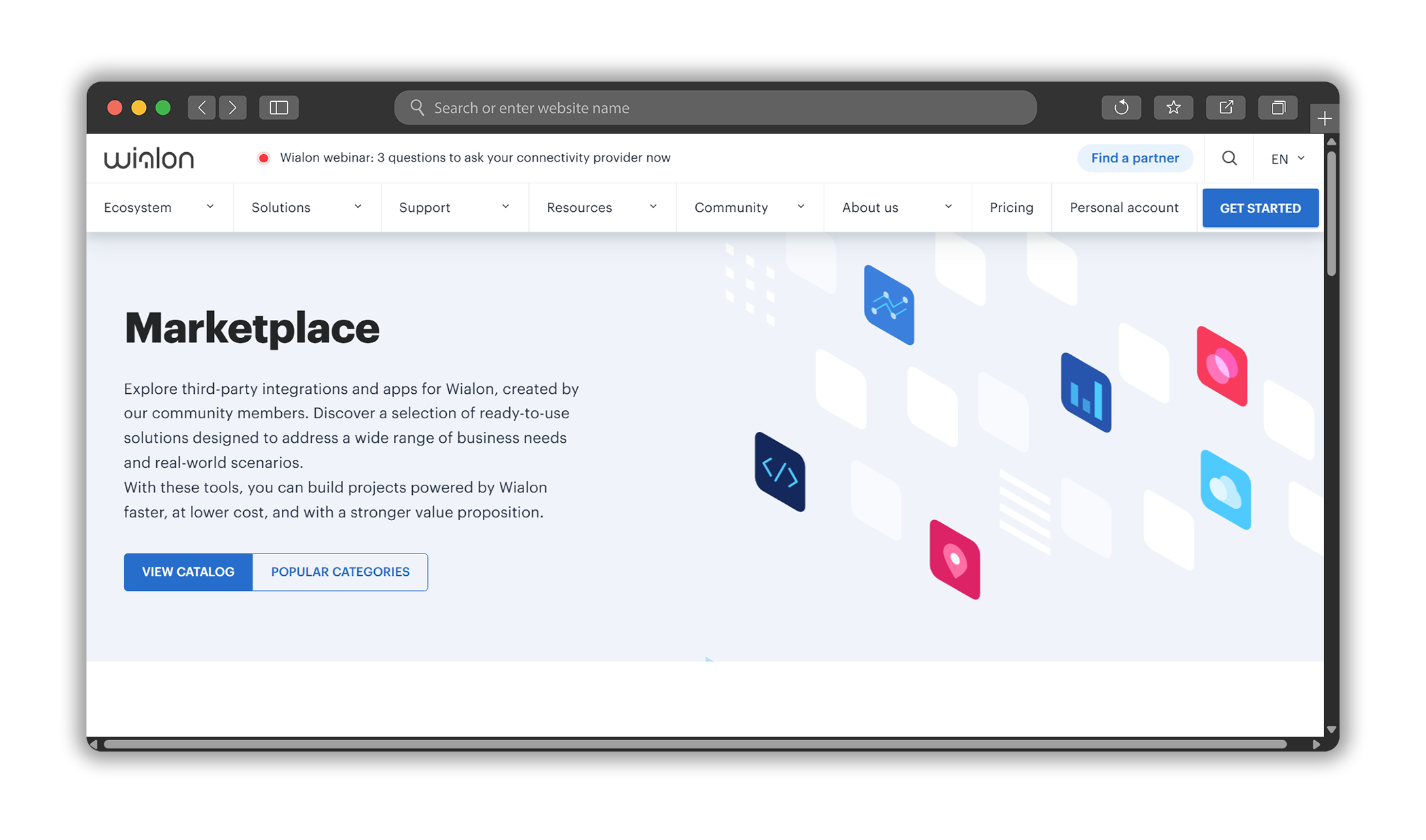
__SLIDER_MARKETPLACE__
Wialon Marketplace features more than a hundred ready-made third-party apps and integrations that can enhance the functionality of your fleet management project
-
Finally, evaluate the commercial and service model. A low-cost initial subscription does not necessarily mean a low total cost once hardware, installation, connectivity, implementation, training, integrations, ongoing technical support, and maintenance are included. For a service provider, the fleet management program must also support sustainable margins and efficient customer onboarding.
Not sure which requirements to prioritize? Read the complete guide to the criteria for choosing a fleet management platform, based on real-world experience from the world's largest community of fleet management service providers.
Comparing fleet management platforms: Where the differences matter
A useful fleet management software comparison should do more than count features. A capability may exist on paper but still come with practical limits: it may require proprietary hardware, be available only in selected markets, or leave little room for a service provider to adapt the final solution.
The comparisons below focus on those practical differences. They look at how each platform approaches hardware, deployment, customization, integrations, and service delivery — and what that can mean once the software is used in a real fleet.
Wialon vs. Geotab
Geotab is a major connected-vehicle platform with its own GO devices, an extensive partner ecosystem, and a growing range of OEM integrations. These integrations allow compatible vehicles and equipment to share factory-fitted telematics data without installing an additional tracking device.
Wialon takes a broader hardware-agnostic approach. It supports thousands of device models from hundreds of manufacturers, giving service providers greater freedom to reuse hardware already installed in a fleet, source equipment locally, and combine trackers, sensors, cameras, and other devices in specialized projects.
Both platforms support complex fleet operations, integrations, and custom applications. The main difference is not simply the number of available features, but how a solution is built and delivered. Geotab combines its own hardware, OEM data, marketplace, and partner network within the Geotab ecosystem.
Wialon gives telematics service providers more flexibility to select hardware, customize solutions, manage multiple customers, and deliver services under their own brand. Wialon may therefore be the stronger fit when hardware independence, white-label service delivery, flexible deployment, or adaptation to different regional and industry requirements is a priority.
__CTA_BANNER_WIALONLITE1__
Wialon vs. Navixy
Navixy and Wialon are both designed for telematics service providers and support white-label fleet management services, a wide range of tracking devices, cloud and locally hosted deployments, and tools for building custom integrations.
Navixy positions itself as an all-in-one platform that helps service providers launch and manage branded GPS tracking and fleet management services. Its ready-to-use functionality, developer tools, and regional customization options can make it a practical choice for providers looking for a relatively streamlined route to market.
Wialon is built for a particularly broad range of telematics projects, from standard vehicle tracking to complex solutions involving mixed hardware, specialized sensors, video telematics, and industry-specific applications. Its extensive device ecosystem and global partner community give providers more options when adapting a solution to different fleets, markets, and operational requirements.
Both platforms deserve consideration from telematics businesses. The choice will depend on the required devices and integrations, deployment model, project complexity, available local expertise, and how extensively the provider plans to customize and expand its services.
Wialon vs. Samsara
Samsara provides a cloud-native connected operations platform that combines software with its own devices, cameras, sensors, and gateways. This integrated model can simplify purchasing, deployment, and support for fleets that want to obtain most components from one vendor.
Wialon follows a different approach. It can be used in the cloud or deployed in a locally hosted environment and supports hardware from a wide range of manufacturers. This gives service providers and fleet operators more control over where data is stored, which devices are used, and how the final solution is configured.
Deployment choice becomes particularly important when a project must meet data-residency requirements, connect to local government or industry systems, operate within a private infrastructure, or comply with country-specific telematics rules. For example, some markets require fleet data to be exchanged with national transport platforms or stored within a particular jurisdiction.
__CTA_BANNER_DATACENTER__
Samsara may be a strong fit for fleets that prefer a standardized, vendor-managed hardware and software environment. Wialon is likely to be better suited to mixed hardware environments, locally adapted projects, and telematics service providers that want to choose their own technology stack and build services for different customers.
Wialon vs. Verizon Connect
Verizon Connect offers fleet tracking, video telematics, driver management, routing, and compliance tools, with a particularly strong focus on fleets operating in North America. Its solutions include support for requirements such as HOS, ELD, and DOT compliance.
The company’s international position has changed in recent years. In October 2025, Geotab acquired Verizon Connect’s commercial telematics operations in Australia and several European markets. Businesses considering Verizon Connect should therefore confirm current product availability, local support, and the long-term service model in their particular country.
Wialon is designed for providers and fleets operating across a broader range of hardware, industries, and regional requirements. Its device compatibility and integration capabilities allow data from different trackers, sensors, cameras, vehicle brands, and OEM systems to be brought together within one fleet management environment.
__CTA_BANNER_CASESTUDIES__
Verizon Connect may remain a relevant option for North American fleets seeking an integrated solution with dedicated US compliance functionality. Wialon is likely to be a stronger fit for telematics service providers, mixed fleets, multi-country projects, and businesses that require greater freedom in hardware selection and solution design.
Fleet management platforms at a glance
Fleets and telematics service providers evaluate software differently. Fleet operators need to understand whether a system fits their vehicles and workflows. Service providers also need to consider branding, multi-customer management, deployment options, and the freedom to build their own services.
|
Decision criterion |
Wialon |
Geotab |
Navixy |
Samsara |
Verizon Connect |
|
Primary customer |
Telematics service providers |
Fleets |
Telematics service providers |
Fleets and physical operations teams |
Fleets |
|
Route to market |
Wialon → service provider → fleet |
Geotab → partner or reseller → fleet |
Navixy → service provider → fleet |
Primarily Samsara → fleet; partners support referrals, installation, and integrations |
Verizon Connect → fleet, directly or through referral and resale partners |
|
Hardware model |
Multi-vendor: devices from many brands |
Vendor + OEM: own devices and factory data |
Multi-vendor: devices from many brands |
Vendor-led: centered on Samsara hardware |
Vendor + OEM: Verizon Connect devices and factory data |
|
Cloud deployment |
Available (Wialon Hosting, Wialon Lite, Wialon Platform) |
Available |
Available |
Available |
Available |
|
Locally hosted deployment |
Available (Wialon Local) |
Not core: primarily cloud-based |
Available |
Not available |
Not available |
|
White-label delivery |
Core: central to the partner model |
Available through OEM/Platform Partners; standard resellers retain Geotab branding |
Core: central to the partner model |
Not core: sold as Samsara |
Not core: sold as Verizon Connect |
|
Multi-customer management for service providers |
Core: built for multiple customer accounts |
Available: supported through partners |
Core: built for multiple customer accounts |
Not core: focused on fleet customers |
Not core: focused on fleet customers |
|
APIs and developer tools |
Available: APIs and SDKs |
Available: APIs and SDKs |
Available: APIs and SDKs |
Available: APIs |
Available: APIs |
|
App marketplace or ecosystem |
Available: Wialon Marketplace |
Available: Geotab Marketplace |
Available: apps and integrations |
Available: apps and integrations |
Available: integration marketplace |
|
OEM data integrations |
Available: supported data sources |
Core: major ecosystem focus |
Available: supported data sources |
Available: selected OEM integrations |
Available: selected OEM integrations |
The fleet management solutions in this guide can all be a strong choice in the right setting. A fleet that wants one ready-to-use system may value a tightly integrated vendor setup, while a service provider may need more freedom to choose hardware, shape the solution, and build customer relationships under its own brand.
Start with the way you work, the control you need, and the role you want the vendor or partner to play. The right platform is the one that fits those priorities today and still leaves room for what comes next.
__CTA_BANNER_FLEETTRENDS2026__
Subscribe to our blog and follow us on LinkedIn, Facebook, and Instagram to stay updated on more insights from Wialon.
Frequently asked questions
Which fleet management software should SMEs choose?
The best fleet management solutions for SMEs are quick to implement, easy for everyday users to adopt, and focused on the workflows they actually need. In practice, that usually means reliable vehicle tracking, alerts, reports, a fleet management app for mobile access, fuel and maintenance tools, and integrations with existing business systems.
The right fleet vehicle management software should also support growth without forcing the company to change platforms as its fleet, team, or operational needs expand.
What features should fleet management software include?
Core capabilities in fleet vehicle management software commonly include GPS tracking, maps, reports, alerts, and fuel monitoring system. Depending on the project, maintenance, driver behavior control, routing, video, compliance, and other tools may be essential for some fleets but unnecessary for others. Specialized truck maintenance software can also be useful when repair planning and workshop records are central to the operation.
What does a telematics project look like and how does it work? Read our explanation and understand the structure of any fleet management solution without complex technical vocabulary.
How do you compare fleet management software providers?
Ask each fleet software provider to demonstrate real workflows relevant to your project. Before choosing the solution, run a pilot with representative vehicles and users. Evaluate implementation, training, support services, data access, security, and total cost of ownership, not only the monthly software fee.
How much does fleet management software cost?
The cost of a fleet management program varies across regions and depends on tracked units, hardware, installation, selected modules, integrations, implementation, support, and contract structure. Do not compare quotes until each vendor includes the same operational scope.
Which fleet management software is the best?
There is no universal winner for every fleet. The best platform is the one that supports the organization’s actual workflows, hardware, integrations, operating regions, service expectations, and growth plans.
Wialon is particularly well suited to telematics service providers, mixed fleets, multi-customer projects, and businesses that need flexibility in hardware, deployment, integrations, and solution design. A more standardized platform may be a better fit for a fleet that prefers to source its hardware, software, and support from a single vendor.
What is the difference between fleet management software and GPS fleet tracking software?
GPS fleet tracking software primarily captures and presents location and movement data. A broader fleet management program uses that data alongside maintenance, fuel, driver, safety, dispatch, cost, and integration workflows. Many modern products combine both categories, but the depth of each function varies.
What should telematics service providers look for in a fleet management platform?
Providers should assess device compatibility, multi-customer administration, branding, configurable workflows, partner margins, deployment tools, technical support, and the ability to add specialized applications. They should also confirm that the platform can serve different industries without requiring a separate technology stack for every client.
Is Wialon the right fleet management platform for your business?
Wialon is designed primarily for telematics service providers — companies that build and sell fleet management services to their own clients. That focus shapes everything about the platform: hardware flexibility, white-label options, multi-client architecture, and an open developer toolkit.
In practice, this means a provider can onboard a new client running 300 trucks with four different GPS device brands already installed — and connect all of them without replacing hardware. Wialon supports over 4,100 device models and integrates with ERP, BI, and CRM systems through open APIs and SDKs, so fleet data fits into whatever workflows the client already has.
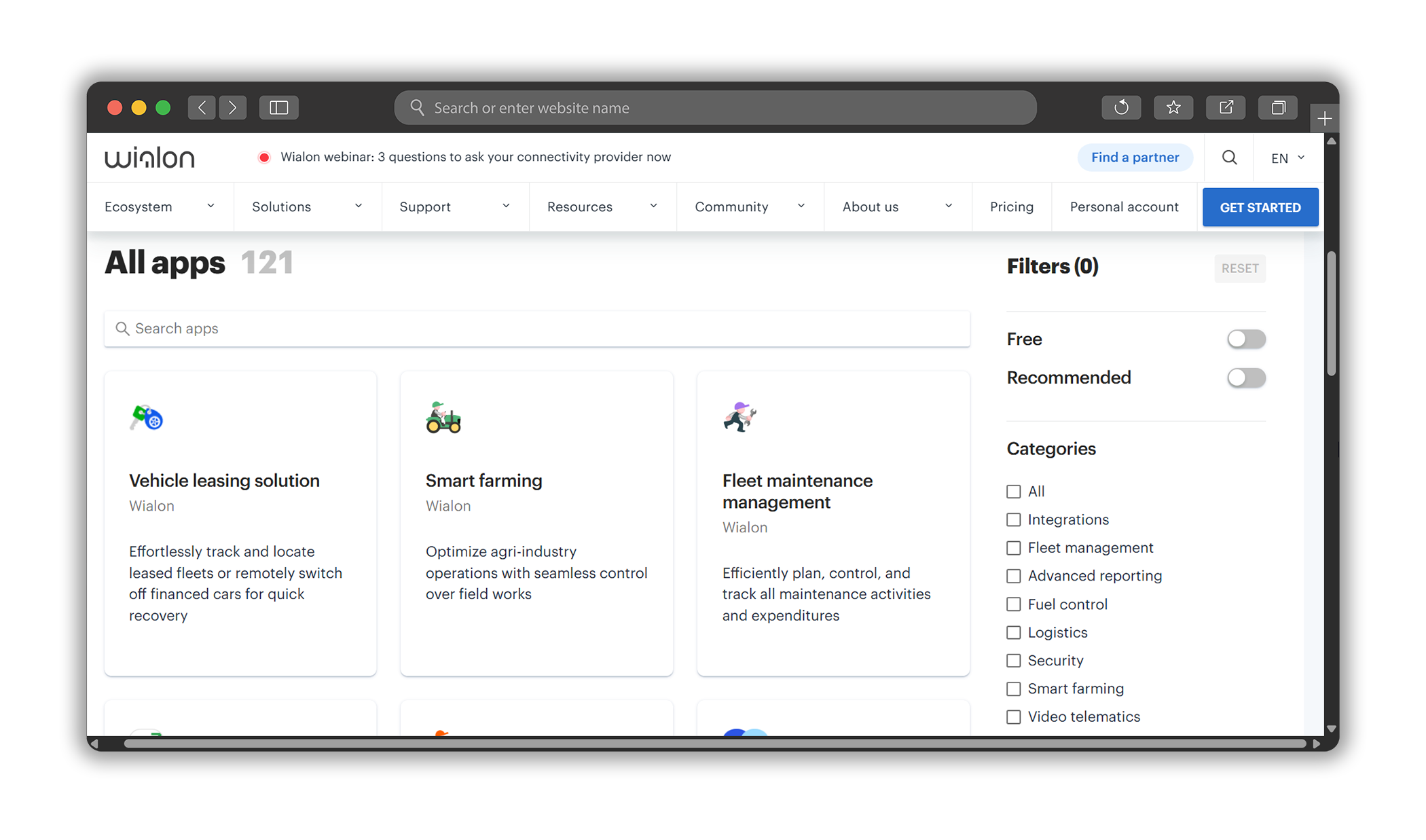
For providers who serve diverse industries, the Wialon Marketplace offers 100+ ready-made apps covering fuel analytics, maintenance scheduling, video telematics, compliance, and more. Instead of developing each capability from scratch, providers pick what each project needs and deliver it under their own brand. The interface is available in 49 languages, and the platform is actively used in 160+ countries.
If your business model depends on serving multiple clients with different hardware, different industries, and different reporting needs — all from a single fleet management platform — Wialon is built around that exact workflow.
Want to see Wialon in action? Request a demo or talk to our team about your fleet, customers, and technical requirements.


.jpg)