May 8, 2026
 6 min read
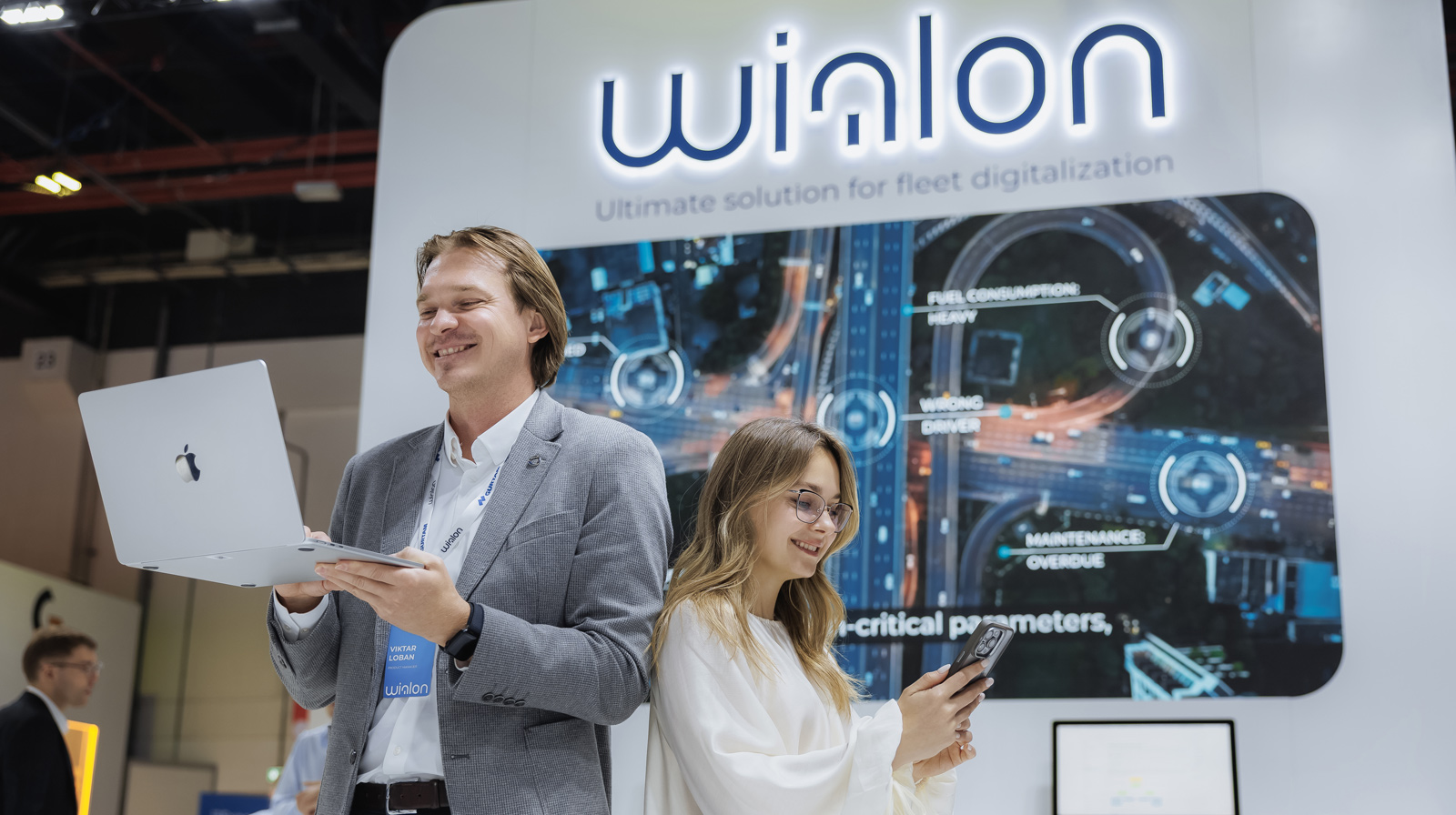
Wialon recently took part in the TelematicsCEEurope Conference & Expo in Portorož, Slovenia — a long-running industry event connecting telematics providers, fleet operators, and technology companies from across Central and Eastern Europe.
Among the many topics covered at the event, AI drew the most attention — not as a future concept but as a practical tool already shaping telematics and fleet management.
This focus was clearly reflected in the dedicated panel “AI in Action: Transforming Industries and Redefining Telematics & Logistics”. The panel brought together Aliaksandr Kuushynau, Head of Wialon and Vladimir Prodanovic, Principal Program Manager at NVIDIA, as well as Franci, the humanoid robot, to discuss AI from both telematics and infrastructure angles.
Between AI ambitions and fleet reality
A key theme of the discussion was the gap between cutting-edge technologies such as AI and everyday fleet operations. Large-scale AI development is moving fast. Infrastructure investments are growing, new tools are appearing almost every month, and the expectations around automation are higher than ever.
But if you step outside of presentations and look at how many fleets actually operate, the situation is far less futuristic.
“On the one hand, we all discuss recent developments in AI and building of gigafactories. On the other hand, we hear news about 14 tons of KitKat being lost in transit between Italy and Poland, showing that companies can still struggle with basic tracking and control.”
— Aliaksandr Kuushynau, Head of Wialon.
This contrast is not a contradiction, it is the current state of the industry. And for telematics providers, it defines the main challenge: not just building cutting-edge solutions, but helping fleets achieve real, tangible benefits from them.
“Our role as technology providers is to bridge this gap and bring these advanced capabilities into real-world operations where they are actually needed.”
A shared role in decision-making
The participants shared their opinions on one of the pivotal questions about our future: when AI becomes widely adopted in fleet management, will it replace humans in making key decisions? Aliaksandr Kuushynau pointed out that even as AI advances, humans will continue to play a central role.
“We will still have a role — maybe not in every small choice, but in deciding what to build, where to invest, and how to guide these systems.”
This means that even in a highly automated environment, human expertise will remain essential, positioning AI not as a replacement, but more as an extension of human capability. By managing routine tasks, AI also frees up time for teams to focus on what matters most. It supports people in scaling their impact, rather than replacing them.
Aliaksandr Kuushynau highlighted Gurtam’s flespi chatbot as a perfect example here. In this case, support was handled by the same technical experts who develop the product. To free up more time to focus on the product features, the team created a dedicated AI support agent to help users with their questions and issues.
“flespi’s AI-powered support assistant now resolves 96% of incoming technical questions — tasks that previously required handling hundreds of requests each week. Despite this level of automation, nobody in the team was laid off. As response speed improved, user engagement grew, bringing more partners and new technical demands. With more time available, the team was able to focus more on building new functionality and further improving the product.”
Turning data into actionable insights
Today, a single vehicle can generate massive amounts of data daily — from location and fuel consumption to diagnostics, driver behavior, and video streams. At first glance, this seems like progress. In practice, it creates a different problem: too much data without clear interpretation quickly turns into noise.
“Fleet managers don’t need gigabytes of data. They need a few actionable insights — something that helps them decide what to fix or improve.”
One of the most important advantages of AI is its ability to reduce complexity. In fleet management, the most obvious use cases include filtering, prioritizing, and translating raw data into more usable information. Fleet digitalization solutions such as Wialon already deliver strong results at scale, and integrating AI can build on this by further simplifying workflows, working with large volumes of historical data, and enabling even greater precision and efficiency in fleet management.
Delivering value while overcoming adoption barriers
Looking at the rapid advancement of AI technology, it may seem that AI-powered tools are already widespread across all industries. However, a closer look shows that the adoption process remains uneven, which is confirmed by our own research.
Aliaksandr Kuushynau shared insights from a survey of Wialon service providers, noting that many already use GPT-like tools in an informal way, and about 20% are developing or already delivering AI-based solutions to customers.
Aliaksandr Kuushynau pointed to the learning curve and organizational inertia — such as resistance to change and slow internal decision-making — as key barriers:
“People are used to running the same reports and processes. While AI can potentially greatly simplify the operational workflows, it takes time to change habits.”
This is especially true for larger organizations, where established processes and scale can slow down day-to-day change. At the same time, effective AI adoption is increasingly becoming a source of competitive advantage: companies that integrate it thoughtfully into their workflows can move faster, gain deeper insights, and operate more efficiently, while those that hesitate risk falling behind.
Wialon’s perspective
For Wialon, AI is not a standalone trend, it is part of the natural evolution of technology. We see it not as a buzzword that simply draws attention, but as a powerful tool with clear, measurable impact.
One of the recent examples of integrating AI into our processes is Lona — a custom-trained chatbot with extensive Wialon expertise, available through My requests. Capable of responding in any language, Lona provides quick initial guidance and aims to resolve partner questions as efficiently as possible, while our support experts are always ready to step in when needed.
Other examples include the Wialon AI Assistant in the Wialon help center and Hardware AI Assistant in the Hardware manufacturers section of our website, along with many more internally used chat bots and tools that ensure the most efficient and productive work of our team.
We integrate AI into our processes not to follow trends, but to improve operational efficiency and deliver more value to our partners. Our goal is to help fleets evolve from basic tracking to structured, data-driven management, and we continue leveraging the AI capabilities to make this process more efficient and beneficial for our partners.
__SOCIALS_EN__

.jpg)
.png)
 (1).jpg)